


Shrimp Farms Achieve Measurable Improvements in Shrimp Farm Performance through Genics’ Biosecurity Audits
Disease outbreaks such as infectious myonecrosis virus (IMNV), White Spot Syndrome virus (WSSV) and acute hepatopancreatic necrosis disease (AHPND) continue to pose significant challenges in shrimp aquaculture, with major implications for farm productivity and economic sustainability. A large-scale Indonesian shrimp farming company partnered with Genics to implement comprehensive biosecurity audits across multiple farm sites. This collaboration resulted in substantial improvements in survival rates, yields, and overall farm resilience, offering valuable insights into the role of structured biosecurity interventions in modern aquaculture.
The Indonesian shrimp industry is a vital contributor to global aquaculture production, but disease-related losses remain a persistent challenge. Pathogen incursions can rapidly spread within and between ponds, leading to high mortality and economic losses. In this context, the producers identified the need to strengthen its biosecurity practices to safeguard its production systems and support its growth trajectory.
Genics was engaged to conduct biosecurity audits aimed at:
- Assessing existing infrastructure and operational practices for potential biosecurity gaps.
- Providing targeted recommendations for improvements based on risk assessments.
- Supporting the implementation of these recommendations through personnel training and ongoing monitoring.
- Establishing a framework for early detection and containment of pathogens to improve overall farm performance.
Audit Scope and Key Measures
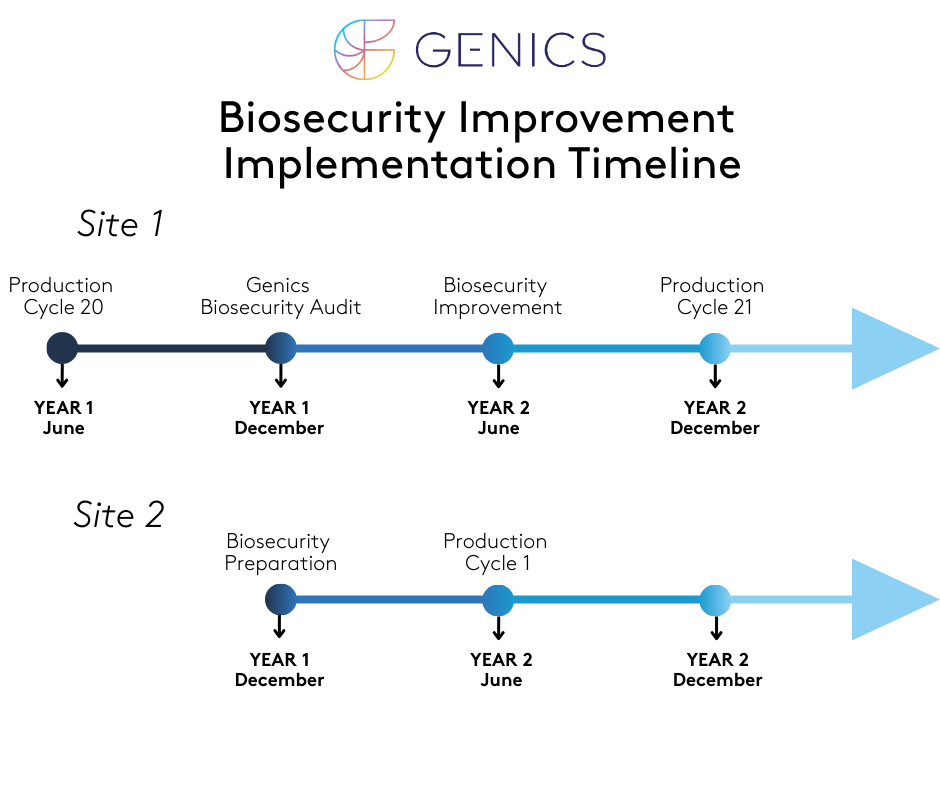
Genics’ biosecurity audits were carried out at two primary production sites: Site 1 (4.41 ha) and Site 2 (11.9 ha). The audits encompassed:
- Infrastructure improvements: Upgrades included the installation of footbaths, fencing, and the adoption of a one-gate system to minimize external pathogen entry.
- Biosecurity zone delineation: Farms were reorganized into distinct biosecurity zones to control the flow of personnel, equipment, and water within each site.
- Water sterilization protocols: Enhanced water sterilization measures during pond preparation and daily operations were implemented to reduce pathogen loads in the environment.
- Stocking route optimization: Stocking routes were redesigned to minimize cross-contamination risks between ponds.
- Standard Operating Procedures (SOPs): Farm-specific SOPs were developed for daily hygiene practices, water management, and emergency response protocols.
- Personnel training: Genics worked with the producers directly to deliver comprehensive training for farm teams, ensuring that biosecurity practices were understood and consistently applied.
- Designation of biosecurity responsibility: A dedicated person in charge (PIC) for biosecurity was appointed at each site, with accountability for maintaining compliance and coordinating with Genics’ team.

Pathogen Surveillance and Monitoring
A critical component of Genics’ approach was the integration of pathogen surveillance into routine farm operations.
- Site 1: Pathogen surveillance across three consecutive cycles identified the presence of IMNV. In each case, early detection enabled the implementation of targeted containment measures, preventing broader disease spread across the site. Additionally, identifying the pathogen source to prevent future entry was achieved.
- Site 2: Surveillance efforts detected pathogens in the first two production cycles. These findings guided immediate containment strategies and informed farm-level adjustments to reduce pathogen pressure in subsequent cycles.
The proactive nature of this surveillance program marked a significant shift in the operational paradigm, moving from a reactive approach — where disease outbreaks were addressed only after clinical signs appeared — to a preventive model focused on early intervention.
Outcomes: Survival Rates and Yields
Implementation of Genics’ biosecurity recommendations led to demonstrable improvements in key production metrics:
Site 1 (4.41 ha)
- Survival Rate: Increased from 71.1% in Cycle 19 to 90% in Cycle 22, representing a 26.6% improvement.
- Productivity: Rose from 28.36 tonnes/ha to 40.6 tonnes/ha, a 43.2% increase.
- Revenue: Increased from IDR 9.3 billion to IDR 13 billion, a 39.4% gain.
- Gross Profit Margin: Improved from 27% to 49%, an 81.5% increase in profit margin.
Site 2 (11.9 ha)
Gross Profit Margin: Increased from 13.8% to 34.69%, a 151.4% improvement in profit margin.
Survival Rate: Increased from 84.21% in Cycle 1 to 94.57% in Cycle 2, a 12.3% improvement.
Productivity: Remained consistent at 16.25 tonnes/ha across both cycles.
Revenue: Remained steady at IDR 12.7 billion in both cycles.
This data highlights the effectiveness of integrating biosecurity measures with operational practices in reducing pathogen-related losses and improving farm-level profitability. Notably, the Site 1 experienced improvements in both biological (survival and productivity) and financial metrics, while the Site 2 maintained consistent production volumes but achieved substantial gains in profitability. The contrasting results at these two sites underscore how baseline performance, site-specific challenges, and implementation intensity, shape the outcomes of biosecurity interventions.
At Site 1, the initial lower survival rates and historical disease challenges created greater potential for improvement. Here, the combined focus on infrastructure upgrades (e.g., footbaths, fencing) and daily operational adjustments (e.g., water sterilization protocols, stocking route reorganization) resulted in tangible gains in survival rates and biomass production. These gains were mirrored by substantial improvements in revenue and gross profit margin, reflecting the direct economic impact of reducing pathogen-related mortalities.
In contrast, Site 2’s already high survival rates and stable productivity indicate that the most significant biosecurity-related gains were economic rather than biological. The increase in gross profit margin likely indicates a reduction in operational costs — such as those associated with disease management and mortality-related losses — rather than a direct increase in harvested biomass.
These quantitative outcomes reinforce the critical role of systematic biosecurity implementation in achieving both biological stability and economic sustainability in shrimp farming operations. They also highlight that the benefits of biosecurity are not uniform across sites; rather, they depend on local conditions, the existing biosecurity baseline, and the capacity of farm teams to adopt and sustain new practices.

Establishment of Dedicated Biosecurity Teams
A notable outcome of the biosecurity audits was the institutionalization of dedicated biosecurity oversight at the farm level. At Site 2, six full-time biosecurity staff were assigned to monitor and enforce daily SOP compliance, including water bath maintenance, equipment cleaning, and shrimp handling procedures. This dedicated oversight ensured that biosecurity protocols were consistently applied and that deviations were rapidly addressed, contributing to the observed gains in survival and yield.
Economic Implications and ROI
Beyond the biological metrics, the economic benefits of improved biosecurity were also evident. The shrimp producer reported a 3-fold increase in profitability within two production cycles following the implementation of Genics’ recommendations.
These findings align with broader industry research that positions biosecurity as a cost-effective investment in farm sustainability, with positive implications for both short-term productivity and long-term market viability.
Key Lessons and Broader Implications
Implementation of these biosecurity measures highlights important considerations for shrimp aquaculture operations:
- Early pathogen detection and targeted response strategies are critical for limiting disease spread and minimizing production losses.
- Physical infrastructure improvements and SOP enhancements must be implemented in parallel to address both environmental and operational risk factors.
- Personnel engagement and clear accountability structures support consistent protocol application, transforming biosecurity from a set of policies to an integrated operational culture.
- Quantitative data on survival rates, yields, and ROI provide compelling evidence of biosecurity’s value as an investment in both animal health and farm profitability.
IMAGE HERE
The collaborative work between Indonesia’s shrimp production industry and Genics demonstrates the tangible benefits of structured biosecurity audits in shrimp aquaculture. The substantial improvements in survival rates and yields, coupled with clear economic gains, highlight the importance of proactive biosecurity measures in managing pathogen risks and supporting long-term farm sustainability.
These findings support to the growing body of evidence that biosecurity is not merely a compliance measure, but a foundational component of resilient and profitable aquaculture systems. As the Indonesian shrimp sector and global aquaculture industry continue to face evolving disease challenges, these lessons offer a practical roadmap for harnessing data-driven biosecurity interventions to achieve measurable performance improvements.
Want to know more about Genics Biosecurity Audits?
Get all the information you need and book a free consultation with Dr. Melony Sellars today.
